Arguably the most important debate in the history of the United States has just finished, and there sure was a lot of arguing done. The first of three debates between Democratic Nominee Hillary Clinton and Republican Nominee Donald Trump gave the candidates the opportunity to reintroduce themselves before America and the world to promote their candidacy for the Presidency of the United States.
Throughout the past few weeks, each candidate has taken time out of their schedule to prep for this debate. In Clinton's case this meant practicing with a Trump stand-in where she was able to solidify her responses into two minute answers as stated by the debate rules. For Trump, debate prep was less sophisticated than Clinton's. Rather than practice answers to likely questions, it seems that he spent more time answering questions in whatever way he felt was best. But which style of preparation ultimately won? That's hard to say.
From the responses I received after watching the debate with fellow students on campus, it appears as if Clinton presented herself as presidential while Trump didn't change from his usual self. Throughout the debate Clinton remained relatively calm whenever Trump interrupted her or tried to talk over her. Clinton seemed to know that using the tactics Trump is best known for, interrupting and name calling, would get her no support in the polls.
However, as some of my peers observed there were a few moments in the debate where they either agreed with Trump or saw why people might be drawn to his candidacy. Most notably when he compared the United States to a business and how he would focus on creating jobs in America rather than ship them overseas. While there are many flaws in his candidacy, it's clear that some Americans like the idea that Trump would use a business background to run the country rather than a more traditional political mindset.
Another stark difference between the two candidates is the number of facts each used when discussing their ideas and opinions on how to move this country forward. Clinton continually used as many facts about the economy and foreign affairs as she could which proved that she has taken the time to look over various briefing books and is familiar with what she is taking about. Trump in comparison used less facts and focused instead on words that generalize his stances on issues such as "bring jobs back" which is helpful in theory but barely describes plans he theoretically would implement.
So the first debate is over. What's next?
What will the second and third debates focus on that this one did not? Will either of the third party candidates Gary Johnson and Jill Stein be on the debate stage with Clinton and Trump? Does it matter that they are or are not? Will the moderator of the next debate attempt to fact check the candidates to a higher degree than Lester Holt attempted to do tonight? Are polls going to change dramatically over the next few days or do Americans even care about what a candidate says during a debate? Does a candidate's two minute answer have the ability to change the mind of a voter or is the election already decided by the time September rolls around? The only way to find out the answer to any of these questions is to tune in for the next debate on Sunday October 9.
Showing posts with label horse-race politics. Show all posts
Showing posts with label horse-race politics. Show all posts
Monday, September 26, 2016

Monday, April 25, 2016
Hillary Clinton's Bases of Support
Defining a candidate's bases of support are one of the most important parts of a campaign because these groups of people are the ones that the candidate can rely on to vote for them during an election. Each candidate has a different base of support based on that candidate's views on policies, social problems, and their background. Normally, each party also has distinct coalition that will vote for any candidate in their respective Republican and Democratic Parties. For instance the Republican Party coalition has traditionally been composed of Southern whites, Evangelicals, Veterans, men, married women, voters who are older, and voters who live in the Central Plains region of the United States. On the Democratic side, minorities such as African Americans and Hispanics, secular voters, members of the LGBT community, single women, voters who are younger, and voters who live on the East and West Coasts of the United States. While these demographics are changing with every election, for the most part these coalitions have remained the same for this year's Presidential Election.
As a candidate running on the Democratic Party ticket, Hillary Clinton is tapping in to these traditional bases of support to strengthen her run for the presidency as well as show that she has the ability to attract voters from all across the country and from a variety of backgrounds. One statement that she has continuously made regarding this idea in recent weeks is that "I've gotten more votes than anybody running on either side" from a "wide, broad base" as she recently announced on CBS's Face the Nation with John Dickerson. By stating these claims, Clinton hopes to continue to add to her supporters as voters realize that she will likely be the Democratic Nominee and potentially the next President of the United States.
According to exit polls from CNN Politics and the most recent New York Primary held on April 19th, this "wide, broad base" of supporters comes from women, voters over the age of 30, and voters who identify with the Democratic Party. While the New York Primary is a closed primary, meaning that only people who have registered with a political party prior to the election can vote, there is still a substantial amount of data that can be gathered from these polls. For instance, Clinton won the women's vote 67% compared to Sanders 37%; the African American vote 75% to 25%; and the Latino vote 64% to 36%. However, when it came to education and income levels, voters were almost evenly split between the two candidates with Clinton beating Sanders in these areas by an average of 10 points rather than something more drastic like 20 or 30 points.
The large margin that Clinton has been able to secure among minority voters echoes the large bases of support that President Obama achieved when he ran for president in both 2008 and 2012. Obama's coalition was made up of younger voters who may have never voted before and minority voters who tended to be overshadowed by other candidates in the race. Clinton has latched on to this idea by promoting her campaign as a continuation of Obama's presidency in some ways, in order to gain support from his supporters.
However, Clinton has had trouble gaining support from specific groups during this election cycle, most notably younger voters under the age of 30. These voters are the voters that helped push Obama to his wins in 2008 and 2012 because they had never voted before and were excited to become a part of the political process and use new technologies such as Twitter to get their opinions heard. These voters tend to overwhelmingly support Sanders as can be seen in many exit polls where Sanders has beaten Clinton by over 30 points when it comes to voters under 30. Clinton has also struggled to gain support from white, rural men and may also be struggling to get votes from unions. Unions are traditionally a large part of the Democratic base, and still are, they just tend to favor Sanders over Clinton in certain cases. One of Sanders' key issues has been income inequality which many unions face as they negotiate contracts for their workers in order to raise wages so that their workers can support themselves. While Sanders has said that he strongly supports the $15 minimum wage movement, Clinton has said that she supports a movement to raise the minimum wage to $12, a number not quite as extreme as $15. Though these positions seem similar to the outside eye, Clinton may need to strengthen her support of an increase in minimum wage as it gets closer to the general election so she can gain support from Sanders' supporters if he does not get the nomination in July.
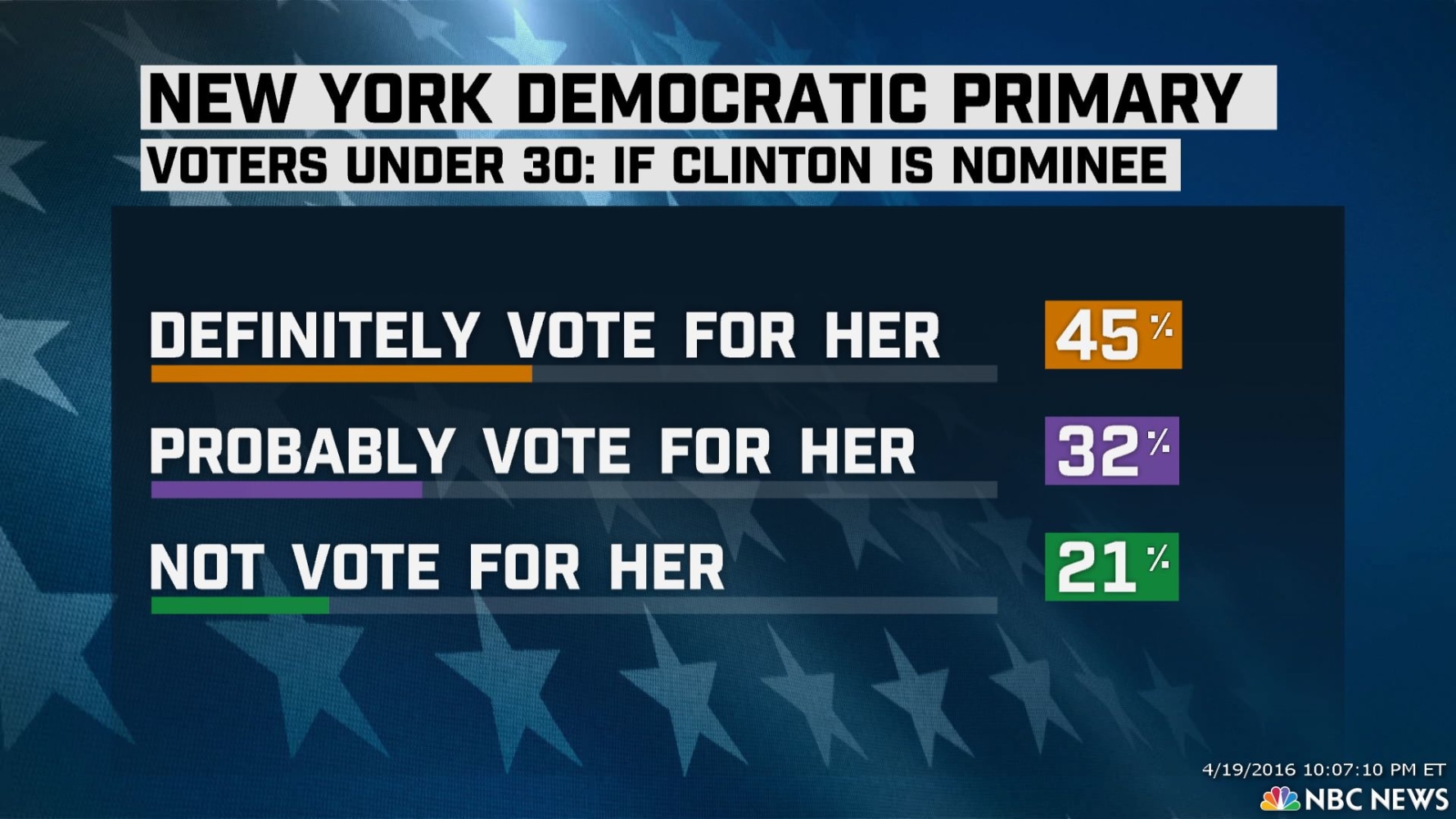
Clinton will need to continue to work on gaining support from Sanders' voters in the coming months in order to ensure that they vote for her rather than voting for the Republican Nominee or not voting at all. The following image is from NBC News as part of their coverage after the New York Primary which shows what voters under 30, some of Sanders strongest supporters, would do if Clinton was the Democratic Nominee. While it is a great sign that 45% would definitely vote for her, Clinton must work to gain support from those who say they would probably vote for her and those who would not vote for her. Gaining support from these voters means that there is a smaller chance for Trump to convert these voters to his campaign and lose the race for the Democrats. To do this Clinton must continue to tout her leadership experience and showcase how her qualities would make her the best fit to be the next president. She will also need to make sure to avoid any gaffes and work on the character that her campaign gives off so that voters can see she is more honest and trustworthy than the media tends to portray her as.

As a candidate running on the Democratic Party ticket, Hillary Clinton is tapping in to these traditional bases of support to strengthen her run for the presidency as well as show that she has the ability to attract voters from all across the country and from a variety of backgrounds. One statement that she has continuously made regarding this idea in recent weeks is that "I've gotten more votes than anybody running on either side" from a "wide, broad base" as she recently announced on CBS's Face the Nation with John Dickerson. By stating these claims, Clinton hopes to continue to add to her supporters as voters realize that she will likely be the Democratic Nominee and potentially the next President of the United States.
According to exit polls from CNN Politics and the most recent New York Primary held on April 19th, this "wide, broad base" of supporters comes from women, voters over the age of 30, and voters who identify with the Democratic Party. While the New York Primary is a closed primary, meaning that only people who have registered with a political party prior to the election can vote, there is still a substantial amount of data that can be gathered from these polls. For instance, Clinton won the women's vote 67% compared to Sanders 37%; the African American vote 75% to 25%; and the Latino vote 64% to 36%. However, when it came to education and income levels, voters were almost evenly split between the two candidates with Clinton beating Sanders in these areas by an average of 10 points rather than something more drastic like 20 or 30 points.
The large margin that Clinton has been able to secure among minority voters echoes the large bases of support that President Obama achieved when he ran for president in both 2008 and 2012. Obama's coalition was made up of younger voters who may have never voted before and minority voters who tended to be overshadowed by other candidates in the race. Clinton has latched on to this idea by promoting her campaign as a continuation of Obama's presidency in some ways, in order to gain support from his supporters.
However, Clinton has had trouble gaining support from specific groups during this election cycle, most notably younger voters under the age of 30. These voters are the voters that helped push Obama to his wins in 2008 and 2012 because they had never voted before and were excited to become a part of the political process and use new technologies such as Twitter to get their opinions heard. These voters tend to overwhelmingly support Sanders as can be seen in many exit polls where Sanders has beaten Clinton by over 30 points when it comes to voters under 30. Clinton has also struggled to gain support from white, rural men and may also be struggling to get votes from unions. Unions are traditionally a large part of the Democratic base, and still are, they just tend to favor Sanders over Clinton in certain cases. One of Sanders' key issues has been income inequality which many unions face as they negotiate contracts for their workers in order to raise wages so that their workers can support themselves. While Sanders has said that he strongly supports the $15 minimum wage movement, Clinton has said that she supports a movement to raise the minimum wage to $12, a number not quite as extreme as $15. Though these positions seem similar to the outside eye, Clinton may need to strengthen her support of an increase in minimum wage as it gets closer to the general election so she can gain support from Sanders' supporters if he does not get the nomination in July.
Clinton will need to continue to work on gaining support from Sanders' voters in the coming months in order to ensure that they vote for her rather than voting for the Republican Nominee or not voting at all. The following image is from NBC News as part of their coverage after the New York Primary which shows what voters under 30, some of Sanders strongest supporters, would do if Clinton was the Democratic Nominee. While it is a great sign that 45% would definitely vote for her, Clinton must work to gain support from those who say they would probably vote for her and those who would not vote for her. Gaining support from these voters means that there is a smaller chance for Trump to convert these voters to his campaign and lose the race for the Democrats. To do this Clinton must continue to tout her leadership experience and showcase how her qualities would make her the best fit to be the next president. She will also need to make sure to avoid any gaffes and work on the character that her campaign gives off so that voters can see she is more honest and trustworthy than the media tends to portray her as.
Friday, April 22, 2016
Strategies for the Democratic Candidate for the General Election
It's been almost three months since the first presidential primary votes were cast in Iowa and New Hampshire and millions of people across the country have cast their votes for who they think should be the next President of the United States. The field of candidates has narrowed from almost 20 contenders at the start of the year to just 5 candidates between the two parties: Businessman Donald Trump, Senator Ted Cruz, Governor John Kasich, Secretary of State Hillary Clinton, and Senator Bernie Sanders. As the party conventions and the general election draw near, candidates will begin to think about the strategies they will need to use in order to win the White House. Because of the traditional demographics that make up each respective party the strategies that candidates use will vary significantly, especially depending on the platform that they have created throughout the election so far. Since I have been following the Democratic Primary, specifically Hillary Clinton, throughout this primary season here are my top five strategy suggestions for her, or Bernie Sanders, for the general election.
1. Focus on the Issues
The point of elections, especially for the presidency, are more than publicly beating up on your opponents and seeing who is leading in the polls, although that is what the media tends to focus on with their "horse-race politics." The issues that candidates talk about on the campaign trail are often the policies that they will try to pass as legislation once they are elected President, so it is important for the Democratic Candidate to clearly state their views on the salient issues of this election. That means stating their stance on income inequality, immigration, gun control, women's rights, LGBT rights, and the economy. These issues have become the most debated topics of this year's election on the Democratic side and are the one's that the American people care about the most thanks to candidates like Sanders and Trump who focus solely on some of these issues at times. Not only would the Democratic Nominee need to talk about their opinions on these issues, but their opinions need to align with the Democratic Party's overall platform as well so that elections held at the state and local level can build off of what the national candidates are doing. Focusing on the issues also helps voters distinguish between the two parties and know which candidates would work on fixing areas that concern them the most.
2. Work on Image and Leadership Qualities
With the New York State Primary held earlier this week, the issue of leadership was a frequent topic of debate among the Democratic Candidates. Accusations that Sanders said Clinton was not qualified to be President of the United States not only hurts that candidate specifically, but the party in general. In comparison to the Republican Party Primaries this year, the Democratic ones have been extremely peaceful and polite and this atmosphere cannot change if the Democrats hope to win the general election in November. Whoever becomes the Democratic Nominee will need to focus on their record of experience and how that will prepare them for the White House whether that is the time they have spent in the Senate or time as the Secreatary of State. The Democratic Nominee will also need to work on their image and potentially continue the image that President Obama has created for the party as one that helps people who are disadvantaged get the rights that they deserve.
3. Unite the Party
Though the Democratic Party has appeared to be more presidential at times than the Republican Party, there is still a certain amount of division within the party. As with any race, supporters of particular candidates are often loyal to their candidate and have a hard time switching their support if their candidate does not win the nomination. However, a scenario where Sanders supports refuse to support Clinton as the nominee or vice versa could be detrimental to the party and potentially lose the White House to whoever the Republican Nominee turns out to be. In order to unite the party to defeat the Republicans, the Democratic Nominee will need to help fund raise for other candidates running on the Democratic ticket at both the local and state level and make appearances for these candidates at various campaign events. This would help create unity because it would show that all of the Democratic candidates have similar views on the issues and make everyone in the party feel like they are important and that their concerns were being heard.
4. Strengthen the Coalition
Every political party has a specific coalition that they depend on during elections to vote for their candidates. On the Democratic side their coalition, or base, consists of minorities including African Americans and Hispanics, younger voters, people who tend not to associate with a specific religion, members of the LGBT community, and people who live on the East or West coasts of the country. By focusing on issues that members of these communities care about such as immigration reform, decreasing the economic inequality among classes, and creating affordable college, the Democratic Nominee will know that on the first Tuesday in November when these groups go vote that they will be voting Democratic. However, the Democratic Nominee cannot depend solely on these people to win the election for them. The nominee will have to broaden their message to a certain degree so that Independents or other undecided voters will consider voting for the Democratic candidate rather than the Republican one.
5. Us vs. Them Mentality
Due to the extremely polarized political world that we currently live in, it is necessary for the Democratic Nominee to play into this mindset of Us vs. Them in order to win the general election. This strategy can work better than it may have in previous election cycles because this year's elections have seem some very nontraditional candidates on the Republican side. By exploiting these characteristics that show how unqualified and disrespectful some of the Republican candidates have been, it could show voters that the Democratic Nominee is much more qualified and trustful to be the next president than the Republican Nominee could ever be. However, the way in which the Democratic Nominee creates this image cannot be extremely explicit. Instead they would need to show their qualifications through campaign ads, speeches, and endorsements rather than simply stating that the Republicans are bad and the Democrats are good because this type of speech could backfire on the Democrats and make them seem greedy more than anything else.
1. Focus on the Issues
The point of elections, especially for the presidency, are more than publicly beating up on your opponents and seeing who is leading in the polls, although that is what the media tends to focus on with their "horse-race politics." The issues that candidates talk about on the campaign trail are often the policies that they will try to pass as legislation once they are elected President, so it is important for the Democratic Candidate to clearly state their views on the salient issues of this election. That means stating their stance on income inequality, immigration, gun control, women's rights, LGBT rights, and the economy. These issues have become the most debated topics of this year's election on the Democratic side and are the one's that the American people care about the most thanks to candidates like Sanders and Trump who focus solely on some of these issues at times. Not only would the Democratic Nominee need to talk about their opinions on these issues, but their opinions need to align with the Democratic Party's overall platform as well so that elections held at the state and local level can build off of what the national candidates are doing. Focusing on the issues also helps voters distinguish between the two parties and know which candidates would work on fixing areas that concern them the most.
2. Work on Image and Leadership Qualities
With the New York State Primary held earlier this week, the issue of leadership was a frequent topic of debate among the Democratic Candidates. Accusations that Sanders said Clinton was not qualified to be President of the United States not only hurts that candidate specifically, but the party in general. In comparison to the Republican Party Primaries this year, the Democratic ones have been extremely peaceful and polite and this atmosphere cannot change if the Democrats hope to win the general election in November. Whoever becomes the Democratic Nominee will need to focus on their record of experience and how that will prepare them for the White House whether that is the time they have spent in the Senate or time as the Secreatary of State. The Democratic Nominee will also need to work on their image and potentially continue the image that President Obama has created for the party as one that helps people who are disadvantaged get the rights that they deserve.
3. Unite the Party
Though the Democratic Party has appeared to be more presidential at times than the Republican Party, there is still a certain amount of division within the party. As with any race, supporters of particular candidates are often loyal to their candidate and have a hard time switching their support if their candidate does not win the nomination. However, a scenario where Sanders supports refuse to support Clinton as the nominee or vice versa could be detrimental to the party and potentially lose the White House to whoever the Republican Nominee turns out to be. In order to unite the party to defeat the Republicans, the Democratic Nominee will need to help fund raise for other candidates running on the Democratic ticket at both the local and state level and make appearances for these candidates at various campaign events. This would help create unity because it would show that all of the Democratic candidates have similar views on the issues and make everyone in the party feel like they are important and that their concerns were being heard.
4. Strengthen the Coalition
Every political party has a specific coalition that they depend on during elections to vote for their candidates. On the Democratic side their coalition, or base, consists of minorities including African Americans and Hispanics, younger voters, people who tend not to associate with a specific religion, members of the LGBT community, and people who live on the East or West coasts of the country. By focusing on issues that members of these communities care about such as immigration reform, decreasing the economic inequality among classes, and creating affordable college, the Democratic Nominee will know that on the first Tuesday in November when these groups go vote that they will be voting Democratic. However, the Democratic Nominee cannot depend solely on these people to win the election for them. The nominee will have to broaden their message to a certain degree so that Independents or other undecided voters will consider voting for the Democratic candidate rather than the Republican one.
5. Us vs. Them Mentality
Due to the extremely polarized political world that we currently live in, it is necessary for the Democratic Nominee to play into this mindset of Us vs. Them in order to win the general election. This strategy can work better than it may have in previous election cycles because this year's elections have seem some very nontraditional candidates on the Republican side. By exploiting these characteristics that show how unqualified and disrespectful some of the Republican candidates have been, it could show voters that the Democratic Nominee is much more qualified and trustful to be the next president than the Republican Nominee could ever be. However, the way in which the Democratic Nominee creates this image cannot be extremely explicit. Instead they would need to show their qualifications through campaign ads, speeches, and endorsements rather than simply stating that the Republicans are bad and the Democrats are good because this type of speech could backfire on the Democrats and make them seem greedy more than anything else.
Subscribe to:
Posts (Atom)