Showing posts with label Bill Clinton. Show all posts

Wednesday, July 27, 2016

Day Two of the Democratic National Convention

"42"

Last night was former President Bill Clinton's time to shine. As the possible first First Man of the United States this speech set the tone for how he would be featured during the remainder of Hillary's campaign. He began the speech, rather unexpectedly, with the story of when he first met a girl. No, not that girl. His future wife Hillary Clinton. It was interesting to see such insight into their marriage when so many people only see this political power couple as two politicians and not as a family unit. Though some might deem this as one of Bill Clinton's less well received speeches due to his greatness as an orator, he still did a good job at promoting the more personal and caring side of Hillary Clinton.

As the second night of the convention drew to a close, singer Alicia Keys performed a montage of some of her most popular songs which ended in a video of Hillary Clinton. Beginning with a digital glass ceiling breaking after showing the previous 43 presidents, Clinton spoke of her excitement at being the first female nominee of a major political party in the United States saying that "while I may be the first, one of you girls will be the next." This video was a general thank you to the delegates and voters who helped her get this far as well a tease at what her speech on Thursday night might be when she addresses the convention in Philadelphia. 

"The Senator from Vermont"

A gentleman almost too good for his election, Senator Bernie Sanders ended his race for the presidency on Tuesday at the end of the roll call voting. After hearing the delegate votes from all of the states except Vermont, Sanders entered the arena and seemed to take a moment to himself as thousands of people chanted his name and showed their love for him. He then graciously nominated Hillary Clinton to be the Democratic Nominee for President which was agreed to by a vocal vote from the convention delegates. 

Mr. Sanders you entered the race essentially unknown and managed to gain over 12 million votes and raise over 200 million in campaign donations. You raised the level of political discourse in this country and motivated a new generation to dream of an America they can be proud of. Though I personally never got to see you when I traveled to New Hampshire earlier this year, I am glad to have been able to witness your candidacy and all that you have brought to this country to make it just that much better. Thank you for your ideas Mr. Sanders and thank you for the decades of service that you have given to this amazing country. 


Monday, April 25, 2016

Hillary Clinton's Bases of Support

Defining a candidate's bases of support are one of the most important parts of a campaign because these groups of people are the ones that the candidate can rely on to vote for them during an election. Each candidate has a different base of support based on that candidate's views on policies, social problems, and their background. Normally, each party also has distinct coalition that will vote for any candidate in their respective Republican and Democratic Parties. For instance the Republican Party coalition has traditionally been composed of Southern whites, Evangelicals, Veterans, men, married women, voters who are older, and voters who live in the Central Plains region of the United States. On the Democratic side, minorities such as African Americans and Hispanics, secular voters, members of the LGBT community, single women, voters who are younger, and voters who live on the East and West Coasts of the United States. While these demographics are changing with every election, for the most part these coalitions have remained the same for this year's Presidential Election.

As a candidate running on the Democratic Party ticket, Hillary Clinton is tapping in to these traditional bases of support to strengthen her run for the presidency as well as show that she has the ability to attract voters from all across the country and from a variety of backgrounds. One statement that she has continuously made regarding this idea in recent weeks is that "I've gotten more votes than anybody running on either side" from a "wide, broad base" as she recently announced on CBS's Face the Nation with John Dickerson. By stating these claims, Clinton hopes to continue to add to her supporters as voters realize that she will likely be the Democratic Nominee and potentially the next President of the United States.

According to exit polls from CNN Politics and the most recent New York Primary held on April 19th, this "wide, broad base" of supporters comes from women, voters over the age of 30, and voters who identify with the Democratic Party. While the New York Primary is a closed primary, meaning that only people who have registered with a political party prior to the election can vote, there is still a substantial amount of data that can be gathered from these polls. For instance, Clinton won the women's vote 67% compared to Sanders 37%; the African American vote 75% to 25%; and the Latino vote 64% to 36%. However, when it came to education and income levels, voters were almost evenly split between the two candidates with Clinton beating Sanders in these areas by an average of 10 points rather than something more drastic like 20 or 30 points.

The large margin that Clinton has been able to secure among minority voters echoes the large bases of support that President Obama achieved when he ran for president in both 2008 and 2012. Obama's coalition was made up of younger voters who may have never voted before and minority voters who tended to be overshadowed by other candidates in the race. Clinton has latched on to this idea by promoting her campaign as a continuation of Obama's presidency in some ways, in order to gain support from his supporters.

However, Clinton has had trouble gaining support from specific groups during this election cycle, most notably younger voters under the age of 30. These voters are the voters that helped push Obama to his wins in 2008 and 2012 because they had never voted before and were excited to become a part of the political process and use new technologies such as Twitter to get their opinions heard. These voters tend to overwhelmingly support Sanders as can be seen in many exit polls where Sanders has beaten Clinton by over 30 points when it comes to voters under 30. Clinton has also struggled to gain support from white, rural men and may also be struggling to get votes from unions. Unions are traditionally a large part of the Democratic base, and still are, they just tend to favor Sanders over Clinton in certain cases. One of Sanders' key issues has been income inequality which many unions face as they negotiate contracts for their workers in order to raise wages so that their workers can support themselves. While Sanders has said that he strongly supports the $15 minimum wage movement, Clinton has said that she supports a movement to raise the minimum wage to $12, a number not quite as extreme as $15. Though these positions seem similar to the outside eye, Clinton may need to strengthen her support of an increase in minimum wage as it gets closer to the general election so she can gain support from Sanders' supporters if he does not get the nomination in July.

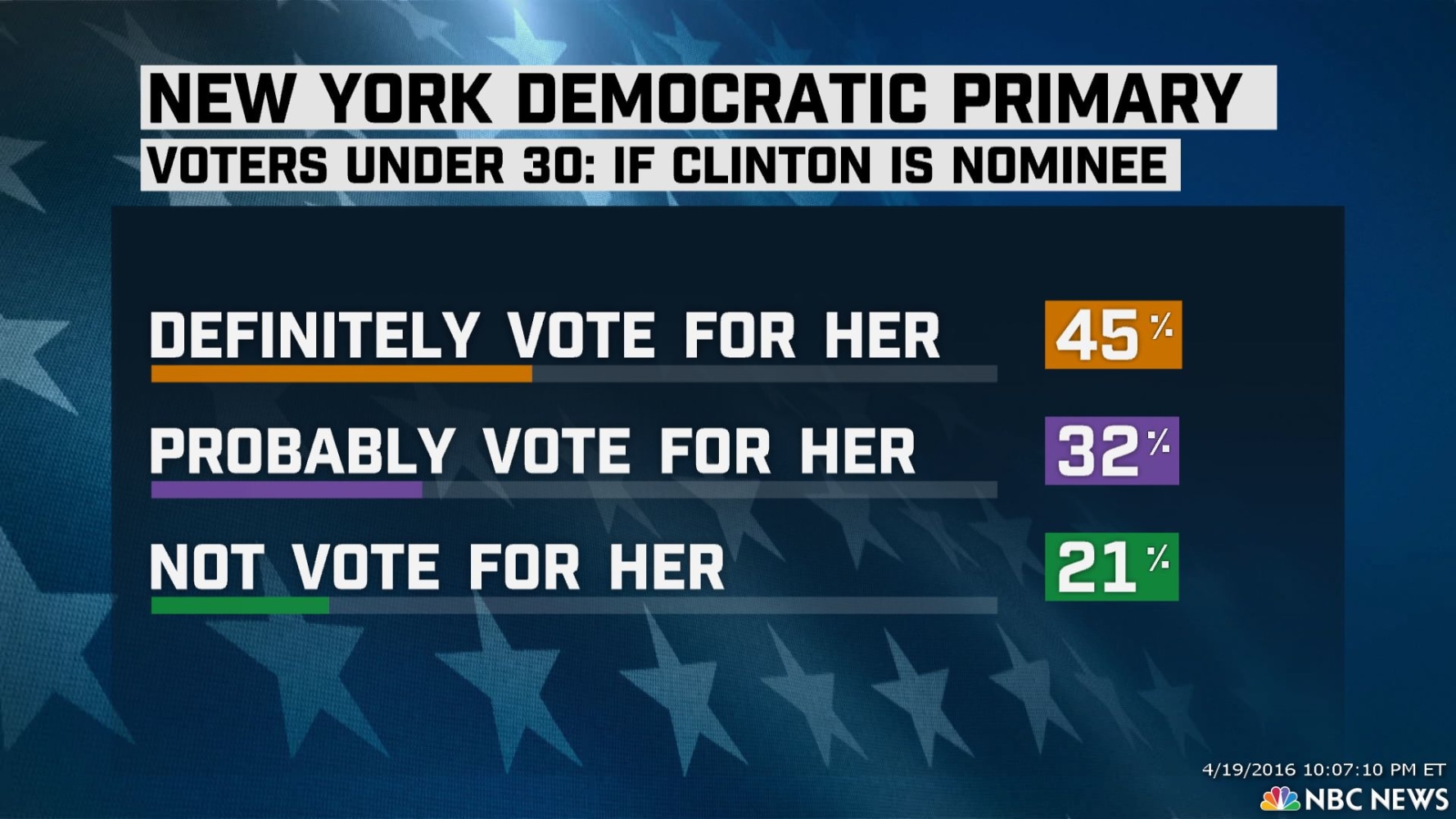
Clinton will need to continue to work on gaining support from Sanders' voters in the coming months in order to ensure that they vote for her rather than voting for the Republican Nominee or not voting at all. The following image is from NBC News as part of their coverage after the New York Primary which shows what voters under 30, some of Sanders strongest supporters, would do if Clinton was the Democratic Nominee. While it is a great sign that 45% would definitely vote for her, Clinton must work to gain support from those who say they would probably vote for her and those who would not vote for her. Gaining support from these voters means that there is a smaller chance for Trump to convert these voters to his campaign and lose the race for the Democrats. To do this Clinton must continue to tout her leadership experience and showcase how her qualities would make her the best fit to be the next president. She will also need to make sure to avoid any gaffes and work on the character that her campaign gives off so that voters can see she is more honest and trustworthy than the media tends to portray her as.

Tuesday, March 1, 2016

Hillary Clinton's Performance and Media Framing of Forum Results 2/18/2016

On February 28th MSNBC hosted a town hall event for the Democratic candidates for president former Secretary of State Hillary Clinton and Senator Bernie Sanders. This town hall was moderated by Chuck Todd and Jose Diaz-Balart both of whom are well known political journalists and have their own political commentary shows on MSNBC.

Unlike other Democratic debates that have occurred so far in the election cycle, this town hall was set up in a way that the candidates took a few questions from the moderators at the beginning of the night followed by questions from the audience for the remainder of the time. Senator Sanders went first and was asked a variety of questions ranging from immigration reform, his ideas on feminism, and his plans to raise the minimum wage over the next 15 years. It was unclear how this town hall would receive Sanders due to his recent image in the media being portrayed as a "single issue candidate." From the beginning Sanders denied that he was a single issues candidate and by the end of the night was able to close Clinton's national lead in the polls from 25 points in the middle of January to just 11 points in the middle of February according to NBC News.

But for a majority of media outlets, Clinton was the main focus of the night. After a double digit loss to Sanders in New Hampshire, the country was eager to see how she would perform. And perform she did. Clinton was precise and almost eager to answer as many questions as she could in a relatively honest, basic manner. When asked about the Supreme Court appointment being considered after the recent death of Antonin Scalia she said that Congress needs to do their Constitutional duty and let the process of nominating someone occur in a timely manner. When talking about this issue, Clinton acknowledged Senator Harry Reid from Nevada and multiple other Congressmen throughout the night. It seemed that this tactic was a way for Clinton to show that she has had experience working with Congress and that she would be able to do so successfully if she were to be elected president.

Clinton also stated that "like many Americans, I have evolved...in my views" when asked about gay marriage and immigration reform. These statements from Clinton were a way to depict her evolution as a politician and associate her with other like minded Americans. In an implicit way Clinton seemed to appeal to voters that have changed their minds on issues from the past to show that she has human characteristics just like everyone else and is more than the disconnected candidate the media has portrayed her as. Because Clinton was predicted to come back from her New Hampshire upset and perform well in Nevada and South Carolina, this town hall was a way for her campaign to reset themselves and begin to look at the larger election.


Monday, February 29, 2016

Hillary Clinton's Performance in Nevada

After a double digit loss to Senator Bernie Sanders in New Hampshire almost two weeks before the Nevada Democratic Caucus, former Secretary of State Hillary Clinton was looking for a resurgence in her campaign. As the grassroots idealism of the Sanders campaign grew, Clinton's campaign was forced to take a step back and evaluate how her campaign needed to move forward towards the next vote. Based on exit polls received from Nevada it was clear that Clinton did a much better job than Sanders in regards to winning a diverse electorate. Voters that were women, voters that were over the age of 45, voters that were African American, voters that were registered Democrats, and voters that were also union workers, voted for Clinton more often than they voted for Sanders according to CBS News. However, Clinton was not able to gain an advantage with Hispanic voters or voters under the age of 45; Sanders continues to crush Clinton with this percentage. Yet Clinton seemed perfectly fine with this.

In her victory speech, Clinton focused on thanking her supporters both in Nevada and around the country for all of the hard work and donations that they have contributed to her campaign. She promised to "break down every barrier that holds you back" and went after the Sanders campaign stating that "we aren't a single issue country...we need more than a plan for the big banks, the middle class needs a raise." These cracks at the Sanders campaign were not the primary theme in Clinton's speech, but were instead used to highlight issues from her traditional stump speech. With the South Carolina primary and Super Tuesday rounding out the first month of official campaigning, Clinton is starting to focus on the general election in November rather than every primary between now and the convention.

Though she needs to find a way to excite young voters, particularly women, she continues to dominate the national media over Sanders. After winning three of the first four contests in the 2016 presidential election cycle, the media is realizing that Clinton still has the power to take the Democratic Nomination in July even with the growing momentum of the Sanders campaign. As the race begins to head South, the media is predicting that Clinton will dominate in almost every contest, especially during Super Tuesday. It seemed as if the media knew Clinton would win Nevada by a reasonable margin that they immediately shifted their attention to her national campaign strategies as soon as she was declared the winner in Nevada. According to Real Clear Politics, Clinton is ahead in almost every poll ranging from the Carolinas, to Michigan, to Illinois. It is clear that the media is predicting a large margin of victory in regards to pledged delegates to Clinton on Super Tuesday, but there is still the possibility that Sanders could have some surprise wins in the Northeast in Massachusetts and his home state of Vermont.

Monday, February 8, 2016

Day Three: The Clintons

From the Christie event our team hit the road to go to a Clinton rally at Manchester Community College. While waiting at the Clinton event I was able to spot several journaists and members of the media including Willie Geist, Mile Barnacle, Sam Stein, and Lawrence O'Donnel. This event was such a unique experience because we were able to see Hillary Clinton, Bill Clinton, and Chelsea Clinton all at once. It was truly a historic moment, no matter if you agree with their politics or not, these are some of the most well known political figures of our time. 

As Chelsea and Bill introduced Hillary, the crowd's intensity steadily grew so that everyone was severely excited by the time Hillary took the stage. She then talked for around 40 minutes about healthcare, making college affordable for young adults, improve our energy standards, work on giving women equal rights, and how we need to take back the country from those who want to destroy it. Her most notable quote from the rally was when she indirectly went after the younger generations who have been supporting Bernie Sanders in record numbers by saying "You may not support me, but I will support always support you." As someone who goes between supporting both Hillary and Bernie this quote struck me because it showed that Hillary is presenting herself as someone who cares more about getting young adults into public service because they want to have a say in their countries future rather than saying something that makes it seem as if she only cares about winning and nothing more. 

However great these speeches were the venue that this event was held at was not the bet to accommodate such a large crowd. Because there were so many members of the mainstream media at this event the number of people allowed in to the arena was very limited. This meant that I had to stand just outside the glass wall that separates those from the room were the Clinton's spoke and the overflow room where I stood. It was slightly annoying to be forced to stand in the overflow area because there was clearly enough room to stand near the back where the media was stationed. But with this being the only downside to this event it was begrudgingly overcome.   

By the way, did I mention I shook former President Bill Clinton's hand and almost got a selfie with him? Because I did and it was awesome! 

Chelsea and Bill Clinton introducing Hillary Clinton. 

The woman of the hour, Hillary Clinton in the flesh. 

My almost perfect selfie with our 42nd President of the United States, Bill Clinton.